
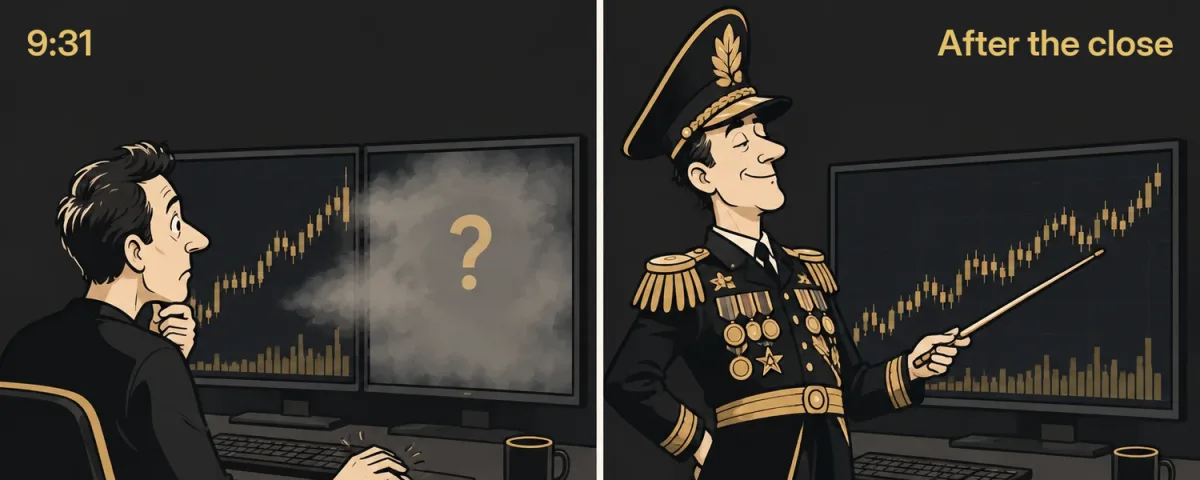
At the end of the day, every trade looks obvious.
I should have gone long. I should have got out earlier. I should have waited. I should have.
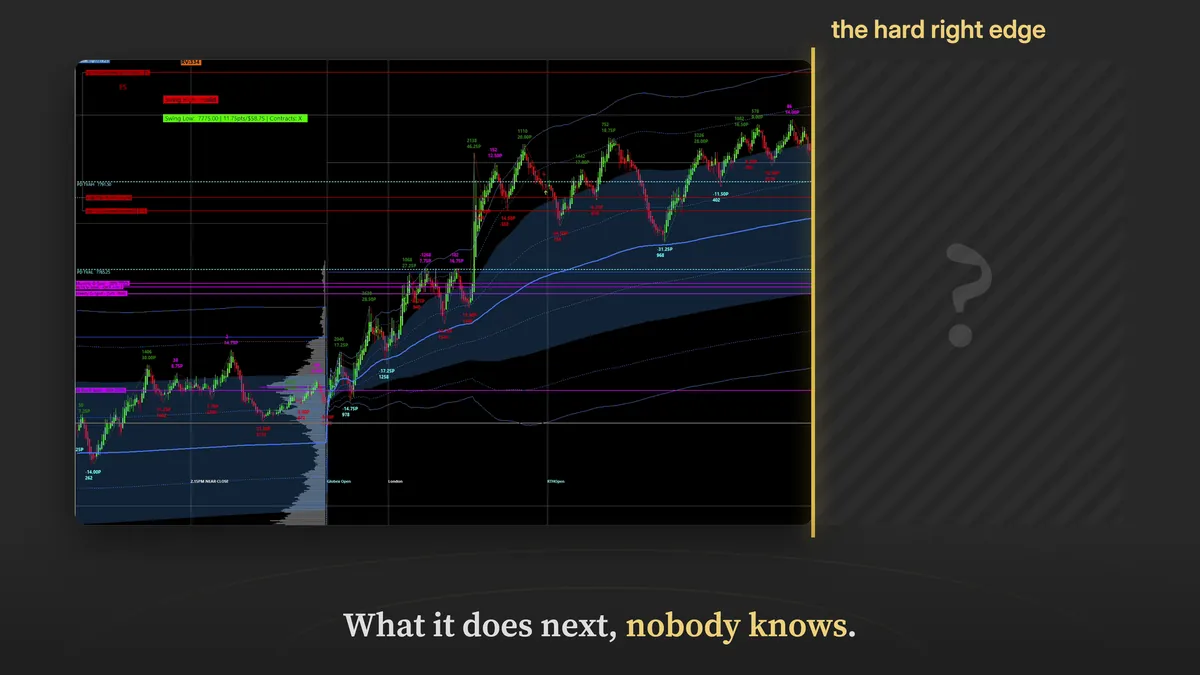
But at 9:31 you didn't know that. All you had was the left side of the chart. You were at the hard right edge, where the market is right now, and what it does next, nobody knows.
It's easy to be a general after the battle. Far too easy, and usually wrong.
I taught day traders for years, in live lessons, in Q&As and in our Discord, where students posted their journals and I commented on them sentence by sentence. This is what I kept telling them about the journal, week after week. Everything here works with a notebook, a spreadsheet or Notion. What matters is when you write, and what you write.
Write it while you trade, not in the evening
Every note gets a time stamp. Why? Because memory and emotions play games. Your brain wants to be right.
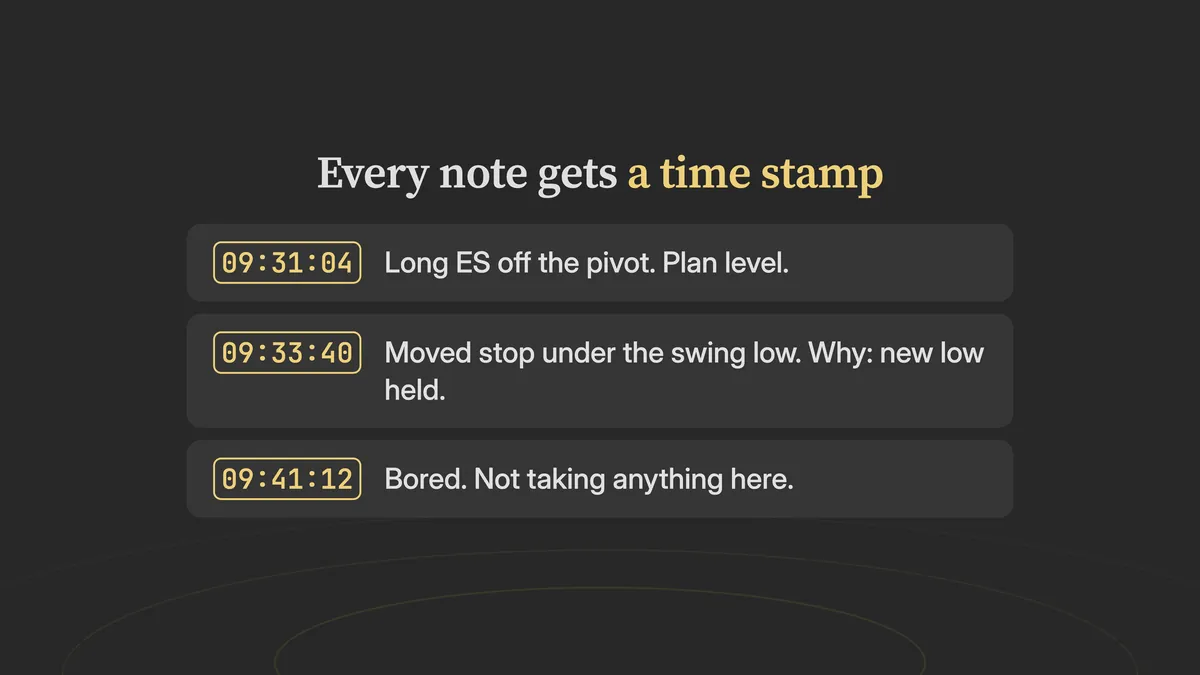
Once the trade is closed, you already know the outcome, and without noticing you bend what you write toward what happened. The winner was suddenly clear from the start. The loser was bad luck. That's not how it was. When you took them, you didn't know how either of them would end.
A serious athlete has his games filmed and watches them afterwards. Not the highlights: the moment he was actually playing, what the game looked like, how the others moved. Your journal is the film of your game.
From practice. In one class I scrolled a student's chart so the right side was hidden, and asked why the trade was taken. The answer described what the market did after the entry. That is exactly what happens without a journal: you can't remember what pushed you to press the button, so you explain it with the future.
From practice. I record most of my serious sessions: a private live stream to YouTube, and I talk out loud while I trade. After the session I have a live journal with every thought tagged to the exact time I said it, and I cut out the key moments for the review. It's a far more honest review than anything else, because it was recorded at the hard right edge, not reconstructed after the close. And talking forces you to put your thoughts into sentences that make sense, which means you have to stay aware the whole time.
From practice. One student wrote this in a journal after four losses in a row:
I probably wouldn't have taken it if I hadn't had 4 losses in a row. I can justify what I'm "supposed to do" based on what I want the answer to be.
The trade itself was a mistake. The sentence was gold. That is exactly what a journal written during the trade catches, and what a journal written in the evening never will.
The circle
A trader's work goes around in a circle, and the circle never closes. Preparation. Execution, built on that preparation. During execution you journal. At the end of the day you review. From the review you draw conclusions, your mistakes and your strengths, and the next day starts with preparation again.
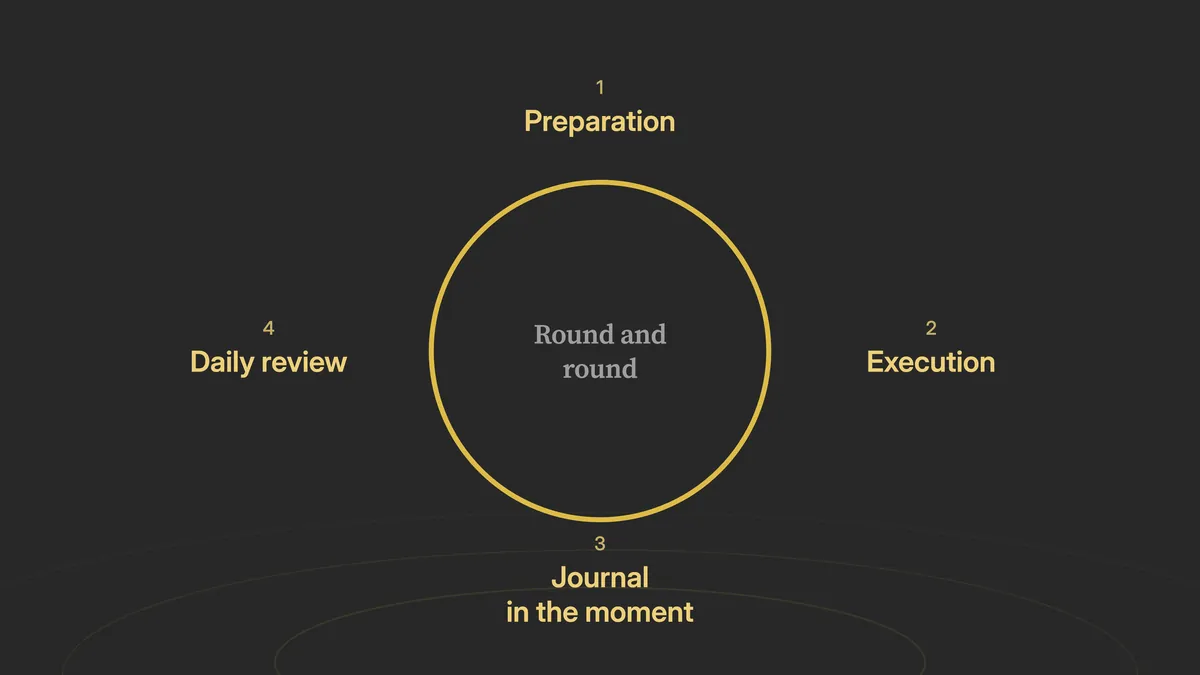
The click on buy or sell is the smallest part of the job. Most of the work happens outside your trading hours. When you come to the market prepared, trading is almost boring. You know your trades, your stops and your targets before the open.
From practice. I told my students the truth about myself: whenever I sat down to trade without a pre-market prep, I lost. When you make the prep, you have already seen the market's possible moves before they happen, so you're ready for any outcome and you don't have to analyze every blip.
And when the prep is wrong, the journal says so. One day I shorted, put my stop in and went to have dinner. I had forgotten the FOMC minutes. Stopped out, no harm done, but my post in our accountability channel that day starts with "Call me stupid!" That's why the economic calendar is the first line of the header.
From practice. My own routine is simple. During the session I write very short notes on paper, almost telegram style, just tagging my thought process. When something interesting comes up, I develop it while it's still fresh, or while I'm waiting for the next trade. In the evening I upload the trades, and the next morning I tag them properly.
What goes into a journal day
The header. The date. The economic calendar: the catalysts the biggest participants have on their agenda. Your process goal for the day, which comes from yesterday's review. Your technical analysis: what you expect the market to do.
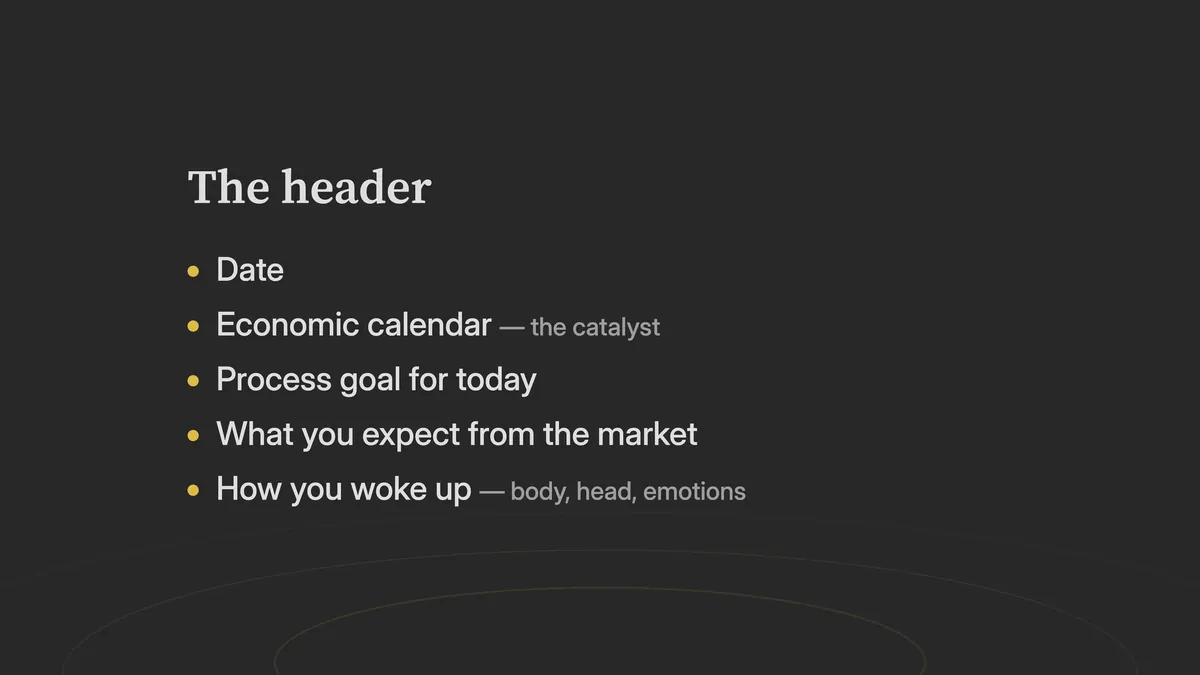
And how you woke up. Your body, your head, your emotions are part of the equipment you take into the game. In my lessons the prep included grading your physical state, your mood and your confidence, and sizing your risk by those, not only by the market. If you're not ready, the best risk management that day is not to trade. Protect your mental capital. A losing streak hurts it badly, and it takes much longer to get it back than to lose it.
Every trade. Time, direction, entry, stop, target, size. Those define the trade and your RR, and they come from your plan. If you don't have a predefined stop and target, you don't have a trade. And one more test: write the reason in one sentence. If you can't put your rationale into a sentence, you don't have the trade.
While you're in it. What do you see, and what do you feel? Here's the interesting part. In the analysis, traders are a hundred percent sure. The moment the risk is on, the brain starts spinning scenarios you never planned, made up out of the fog of fear that you'll lose money. So you write why you entered, and why you made every change. Moved your stop? Why? Took a partial? Why there, and not somewhere else? All of it, at the time it happens.
From practice. Once I closed a short one tick before my stop, just to save that one tick of risk. The market turned right there and went about 150 points in my direction without me. I didn't follow my process. I got cocky and discretionary, and I paid for it in profit I never made. The trade, the exit and my crying afterwards are all still posted in our room, with time stamps. That's the point: in the journal it can't start to look better with time.
The same test works for closing a winner early. The trade is well in profit, starts giving some back, and every part of you wants out. Write down why. If you can't write a reason, it's fear: you don't want to lose the paper profit. The reason to exit should come from the market, not from your psychology.
The trades you didn't plan, and the trades you didn't take. If you broke your process, write it down. If you saw a trade and didn't take it, write that one down too. They teach you a lot about yourself and about the market. And don't panic about them: you will miss more trades than you take in your whole career. Rushing in so you don't miss one exposes you to the worst trades and damages your mental capital.
Emotions, plainly. If you're bored, write "I'm bored." Don't dress it up. The journal isn't for anyone but you.
The daily review: not a word about P&L
After the session, the first, the real and the only question is: did I meet my process goal today? Did I follow my plan?
We can lie to everyone. If we lie to ourselves, we commit the mortal sin of trading.
Then every trade, seen through the process, not through P&L. Risk, entry, stop, exit. Was it planned? What were the reasons? Did I do what I said I would do?
From practice. A student once opened a journal entry with:
Very good start of the day. 2/2 winners.
I wrote back: nice, but wrong. A very good start of the day is when you do your process, get your setup and execute it flawlessly. The outcome doesn't matter. The name of the game is expectancy and sample size.
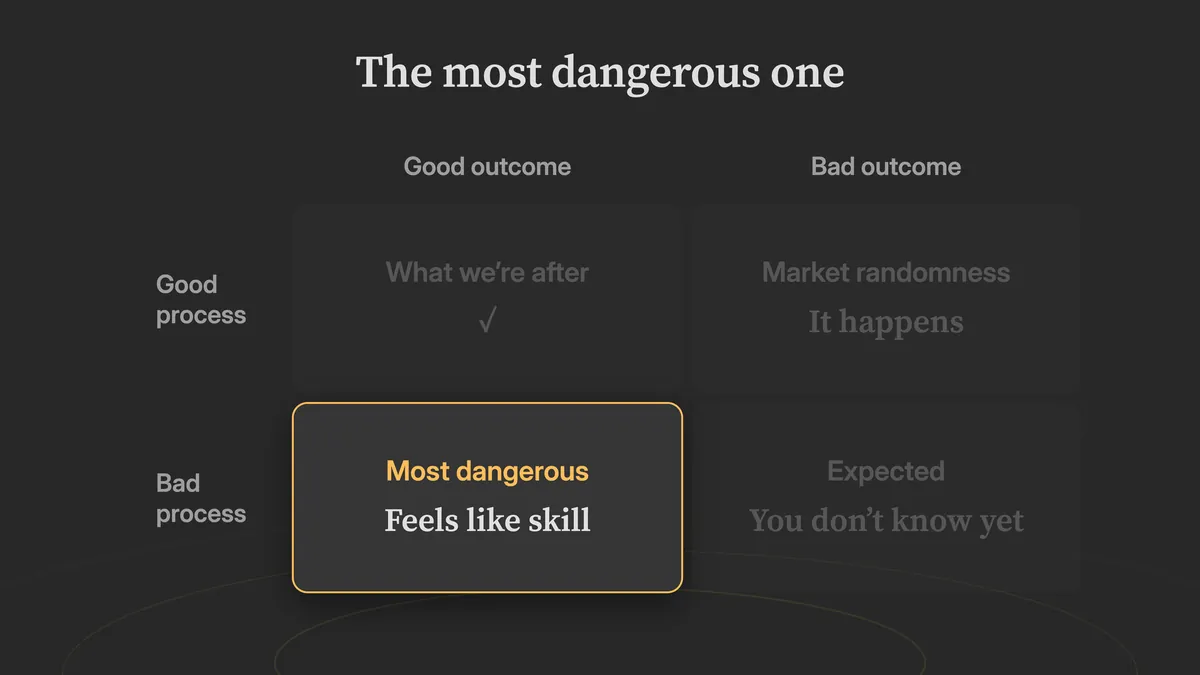
There are four ways to look at a trade:
- Good process, good outcome. That's what we're after.
- Good process, bad outcome. That's market randomness.
- Bad process, bad outcome. What you'd expect.
- Bad process, good outcome. The most dangerous one for a new trader.
The last one makes you feel smart and fixes your bad habits in place. It's the trade where the market gives you a Lambo today and takes your house tomorrow.
From practice: Y and N. A simple review tool I gave students. Mark every trade Y if it was executed by your process and your prep, N if it wasn't. Then add up the Y trades and the N trades separately. Do it honestly and you'll see whether you're profitable when you stay inside your process, and what the N trades cost you. Then just stop making the trades you'll mark N. Not by being trigger happy, but by pushing everything the market gives you through your process, and pulling the trigger only when the process says so.
A mistake is defined by your style, not by the result. For me, taking a scalp is an error whether it makes money or not, and usually I know it the moment I click.
From practice. A student once came to a review sure the day was full of mistakes. We went through it together, and it was really one mistake: trading at all while distracted. Everything else followed from that. That's also why I asked students to post their preps and journals where others could read them. Even if nobody answers, writing it for others forces you to formulate your thoughts, and once it's written, the emotion steps back.
Mistakes that repeat
One mistake is chance. The same mistake day after day is a habit, and that's statistics too. A dollar you lost buys exactly as much as a dollar you made, so your P&L depends just as much on the trades you lost and never had to take.
One of my tags is "stupid trade": no setup, forced, just because it might work. My biggest losses come from exactly those trades.
It was the same with my students. Their biggest losing days were the days with the most trades: lose the first one, and they start trading their P&L instead of the market. I lose the most money by forcing trades, forcing my opinion on the market instead of waiting for the market to tell me what to think. Usually with a great excuse: I'm bored, I can't wait, I have a meeting in two hours. Trading is like a fart. If you have to force it, it's probably shit.
Two rules I trade by. If I get stopped out three times at the same place, I stop and rethink, because maybe I'm really not right. And when a day goes against you trade after trade, ask whether it's the market or you. If it's you, stop trading for the day and protect your mental capital.
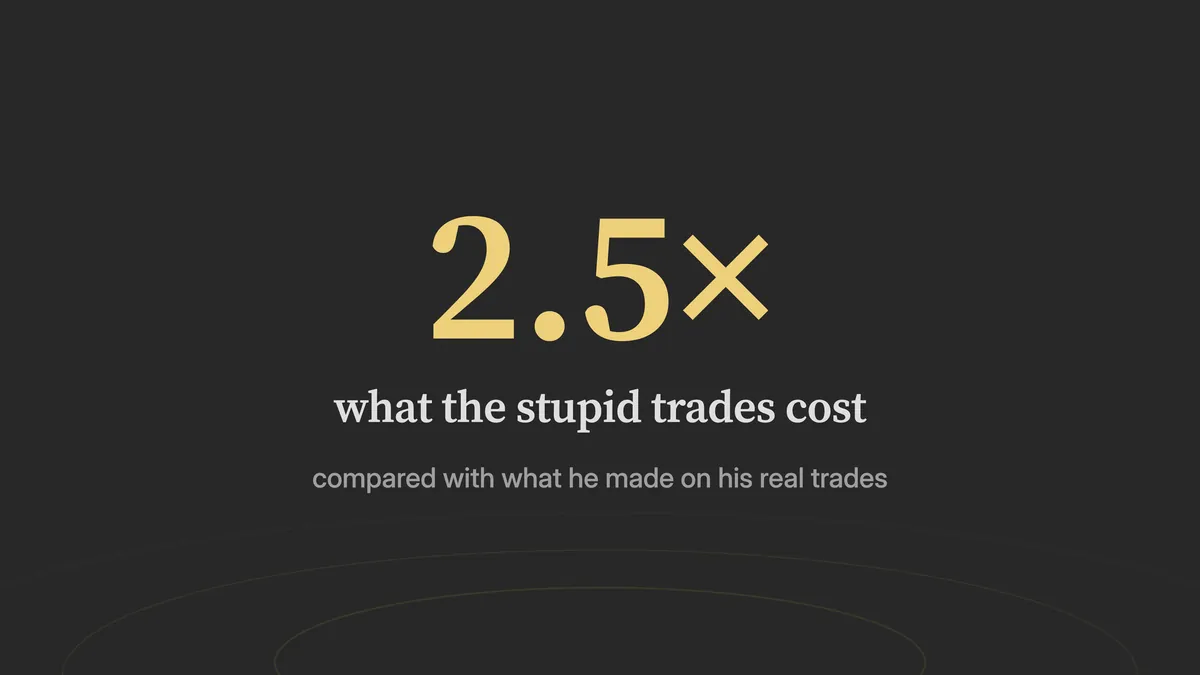
From practice. A student had a red week. Quite a red week. In the weekly review I told him to find every stupid trade: every time he forced it, got in out of boredom, did whatever. When he added them up, the stupid trades had cost him two and a half times what he made on his real trades. The next week he was green, and he hadn't learned anything new. He just stopped taking stupid trades.
But don't beat yourself up. Look for what you did well, because that's what you build on.
One goal for tomorrow
Finish the review with one goal for tomorrow, or one for next week. One. If you give yourself ten, believe me, you won't reach a single one. We're not algorithms, we're people with emotions, and emotions aren't bad in trading. They're a safety mechanism. You just need to know what they're telling you.
From practice. A student once posted a journal with goals for the next week and a note that the review would come later. Backwards. Goals come out of the review. Do the review first, then set the goal, with a plan for how you'll meet it.
The weekly review: statistics
I look at my profit once a week, at the weekend, when the market is closed. I use it to set my risk for the next week. During the day I honestly don't know how much I'm up or down, but I know very well whether I'm trading well or badly.
Statistics without a sample mean nothing. We want you to be the casino, and casinos have boring bookkeepers. For each setup, twenty trades is the bare minimum, a first data point. Around sixty is a sample you can trust. And if your statistics say you're bad, you're bad. Numbers don't ask how you feel. The market doesn't care who you are, only how you do it.
I split statistics in two. General statistics tell you about your state of mind when you trade. Relative statistics, per setup and per part of your setup, tell you about your edge and how well you execute it.
Win rate on its own tells you very little. The numbers I asked students to look at:
- holding time of winners vs holding time of losers;
- average winning trade vs average losing trade;
- biggest drawdown vs profit over the same period.
From practice. My average winners last anywhere from half an hour to a few hours. My average losers are usually over within 10 to 15 minutes. Monday and Friday were my worst days: on Monday my head isn't at working temperature yet, on Friday it's tired. If you keep losing at certain hours, it could be the market, or it could be you losing focus.
From practice. In class I gave students this one: a month that ends up 6%, but was down 20% at one point along the way. Would you give this trader your own money to trade? A student said the sample was too small. My answer: that's gambling with my money.
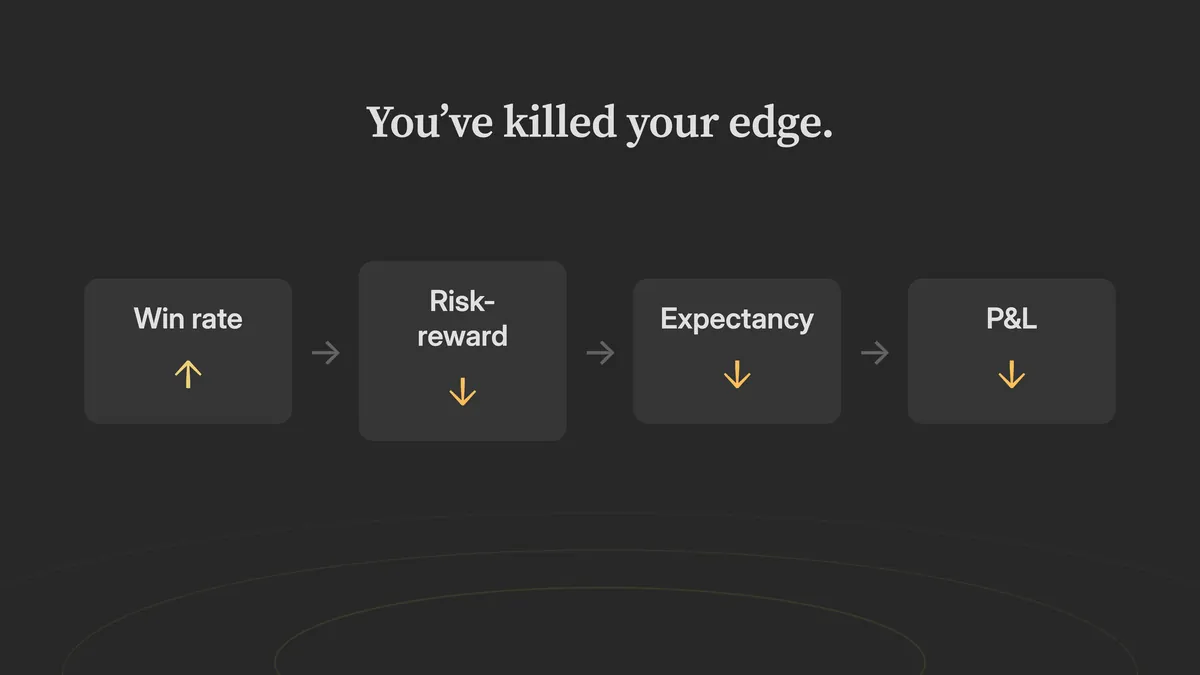
The big warning. Don't change your trading to make your statistics look better. If your win rate is low and you start closing trades as soon as you're a little in profit, your win rate goes up, and you've killed your edge, because you've killed your RR. Expectancy is win% x avg win - loss% x avg loss. Cut the average win and you've cut the thing you live on. On some of my best days I had 28 to 35 percent winners. A 25 percent win rate is fine with a 3-point stop and a 60-point target.
From practice. A student wrote in a journal, mid-trade:
You don't go broke taking profits.
I wrote back that this sentence is probably the main reason most traders go broke.
Tags. Keep them few, and keep them the same. Change them only at the start of a cycle, say a month, never in the middle, or you destroy your sample. A hundred tags tell you nothing. Five good ones tell you everything.
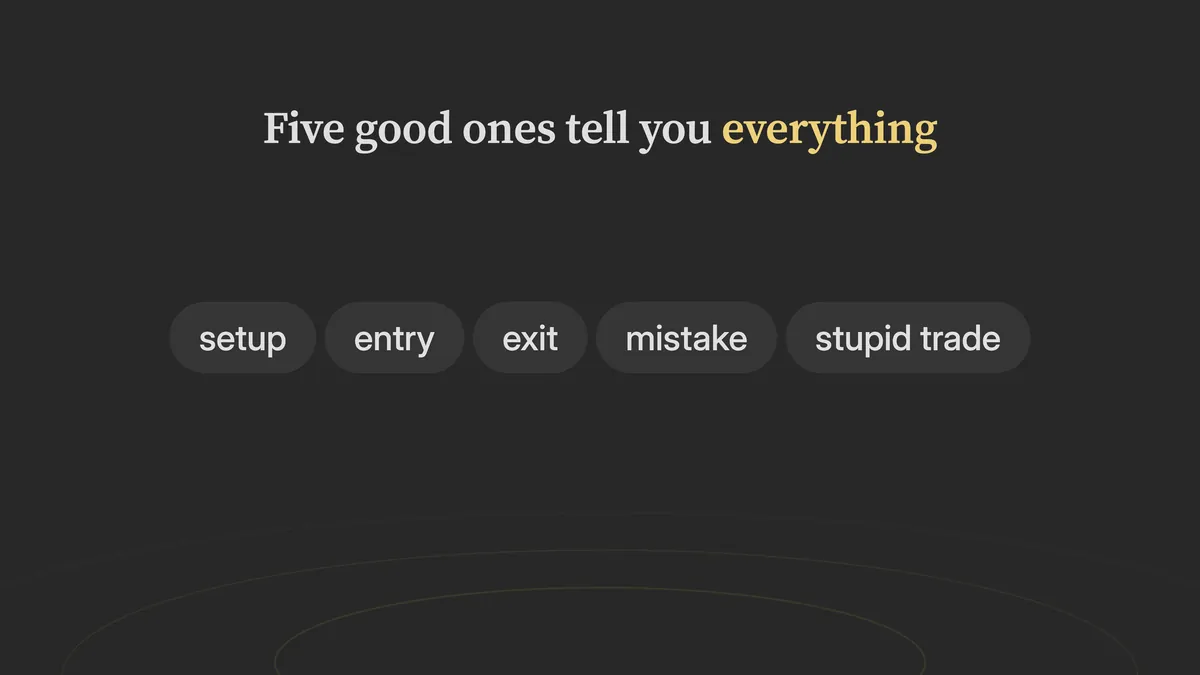
Tags grow like a tree: setups first, then deeper into each setup. A trade that fits two setups gets both tags.
From practice: the "early exit" tag. It marks a winner I closed before my planned target, when price later reached the target anyway. If 80 of your 100 winners carry that tag, you know exactly where your error is. Set the target and walk away from the computer.
When a setup keeps losing, don't drop it, or you'll never learn it properly. Size it down as far as you can, and make your goal for the month better statistics on that setup, not P&L. And write down the market conditions. A setup that works like a charm in a trending market can bleed in a rotation. That doesn't make it a bad setup. It's the wrong tool for those conditions.
Size, fear and the sample size of your losses
Once you've gone around the circle a few times, you increase size. Slowly, so that a possible loss never freezes your hand.
I set my risk once a week, from the weekly numbers: if the week added enough, one more contract. Do not protect your equity through trading. Protect it through the risk.
From practice. After a monster day, size down, or even trade the simulator the next day. Once I made over three thousand points in a day, and in the next two days I lost almost four thousand.
From practice. One student came to me with fear on every trade. The risk calculator explained it: the student had jumped to two mini contracts. Counted in losing trades, that account could now take about eight losers in a row before it was gone, or four to five once you count the trailing drawdown of a prop account. Nobody handles emotions in those conditions. You should feel fear with that kind of oversizing. In the course we sized so that the account could survive around sixty losing trades in a row. Ask yourself the same question about your account: how many losers in a row can it take? If the answer is a handful, your fear isn't a psychology problem. It's a sizing problem.
The process is a better trader than you
The process is a better trader than you or me. If you don't follow it consistently, you can't even tell what works and what doesn't. The result is exactly as consistent as you are. Consistently do stupid things and you get a consistently negative P&L.
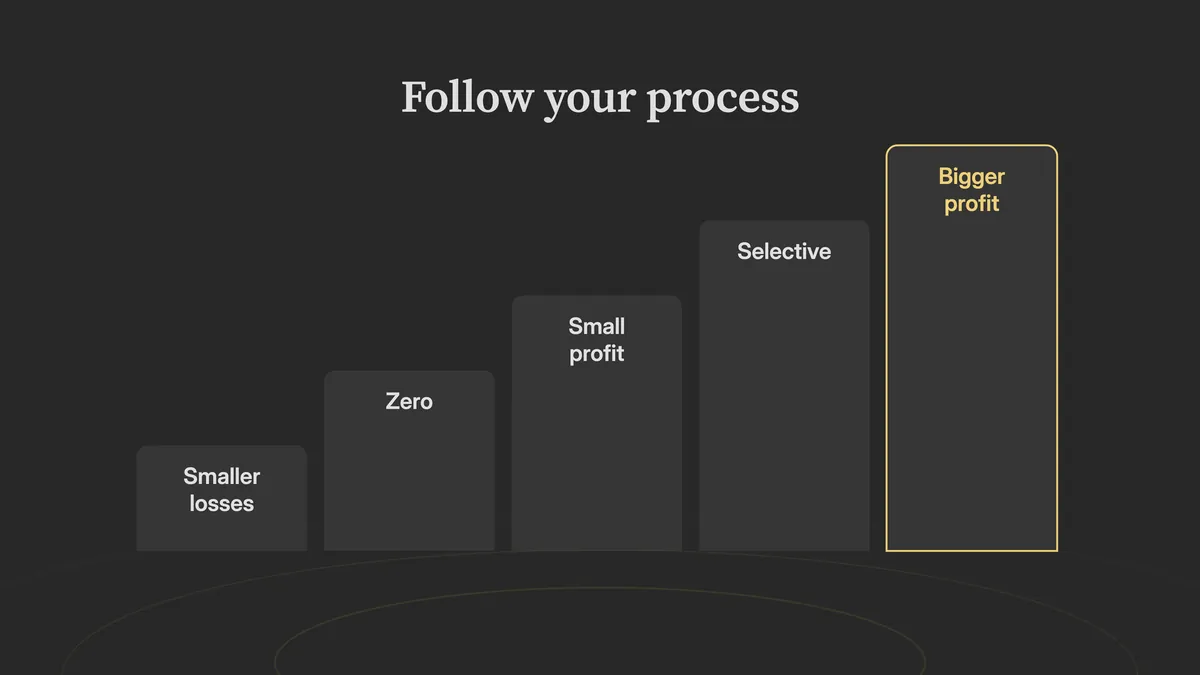
Follow your process and your losses get smaller. Then zero. Then a small profit. Then you dig deeper, see where you lose the most, become selective, and the profit grows. And round you go again.
If you trade a prop account, read this twice. You can trade perfectly well in the evaluation, get the funded account and blow it, because you start to slip from your process and protect the account. It's human, and every trader I know went through that phase. The process is what got you the account. Protecting the account instead of following the process is what takes it away. You are the problem of your trading, not the market.
From practice. The RTH open used to be too fast for me. I practiced it on weekends, on replay, at two, three and four times speed. After that, the real open felt slow. That's deliberate practice: find the weakness in your journal, then train exactly that.
There's a line from a legendary trader, John "Rambo" Moulton, that I gave every class: the next trade is the most important trade in your life. Not the last one, the winner or the loser. Just the next one. And once you're in it, it shouldn't matter for your state of mind anymore, because its outcome is random. The market isn't random in the long run, but your single trade is.
Tools
Everything in this article works with a notebook and a pen, a spreadsheet or Notion. I built TradeRecall because, after years of teaching, I saw that journaling may be the hardest habit for new traders to build. It records while you trade, in the background: your fills from Sierra Chart or NinjaTrader, a chart picture at every fill, and what you say while the trade is on, tied to that trade. It stays on your own computer. The manual journal is free. The automation is free for 30 days, no card.
The full lesson on YouTube: https://youtu.be/1tLQ9omja8M
Process is leading. Money is following.